
May 22, 2025
The Power of Companionship for Seniors: A Key Ingredient to Quality AgingDiscover how companionship in old age boosts health, happiness, and dignity for seniors in Greater Pittsburgh. Learn more today!
Read Article
.svg)


Flexible home care refers to personalized in-home support that adapts to a senior's actual needs — with no rigid hourly minimums, no one-size-fits-all schedules, and no unnecessary visits.
Here's what you need to know at a glance:
| Feature | What It Means for Your Family |
|---|---|
| No hourly minimums | Care can be as short as 15-30 minutes |
| Custom scheduling | Visits happen when your loved one actually needs them |
| Personalized tasks | Help with hygiene, meals, companionship, and more |
| Outcome-focused | Care is built around wellbeing, not just time on the clock |
| Supports aging in place | Seniors stay home longer, safely and comfortably |
According to AARP, 80% of people prefer to stay in their own homes as they age. Yet traditional home care often requires a minimum of four hours per visit — far more than many seniors actually need day to day.
That mismatch leaves families stuck. Too much care feels wasteful. Too little feels risky. And as care costs have risen by at least 10% year over year, the pressure to find a better solution has never been greater.
Flexible home care closes that gap. It gives your aging parent exactly the support they need — whether that's a short morning visit to help with hygiene, a check-in for medication reminders, or a few hours of companionship each week — without paying for time that isn't needed.
For families caring for a parent with Alzheimer's, dementia, or age-related decline, this approach can be the difference between your loved one thriving at home and an early move to a facility.
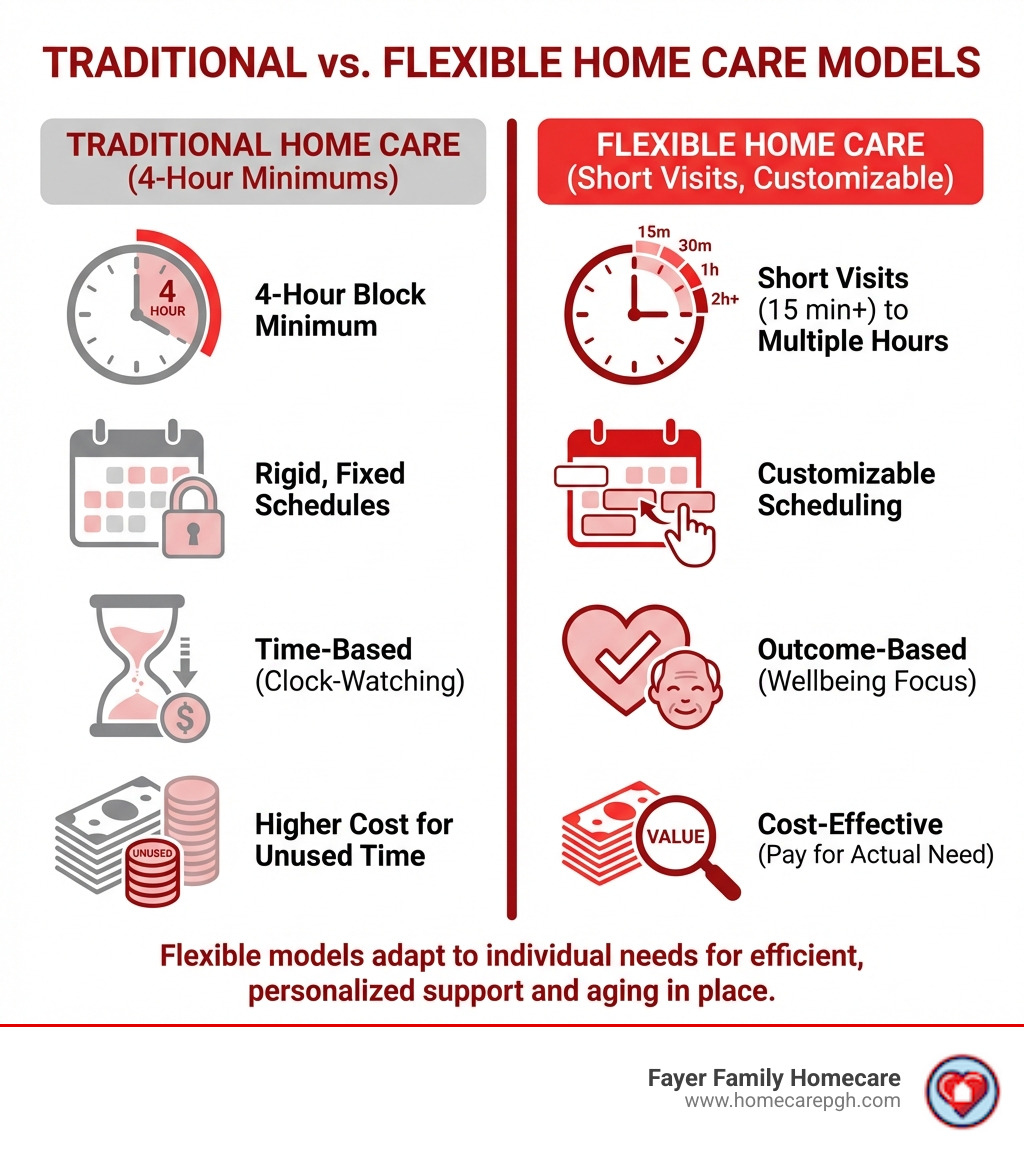
When we talk about traditional home care, we are usually talking about the "four-hour block." For decades, the industry standard has been to require a caregiver to stay for at least four hours at a time. While this works for seniors who need intensive help, it doesn't always fit the reality of "aging gracefully." Many of our neighbors in the Greater Pittsburgh Area just need a hand getting out of bed, a reminder to take their heart medication, or someone to ensure the stove is off after breakfast.
Flexible home care flips the script. Instead of forcing a senior to adapt to an agency's schedule, the care adapts to the senior. This model includes:
By utilizing customized care, families can design a "patchwork" of support. This might mean a one-hour visit in the morning for hygiene and a 30-minute check-in at night for safety. It’s about care in the home services that feel like an extension of the family rather than a clinical intrusion. This person-centered approach ensures that the senior remains the director of their own life, maintaining their dignity while receiving the exact level of help required.
The shift toward flexibility isn't just a convenience; it’s a financial and emotional necessity. With the cost of care rising at least 10% annually, paying for a four-hour block when your loved one only needs 45 minutes of help with a shower is a heavy burden for middle-income families.
| Traditional Care Model | Flexible Home Care Model |
|---|---|
| Strict 4-hour minimums per visit | No minimums or very short (30-60 min) visits |
| Fixed, repetitive schedules | Dynamic scheduling based on daily needs |
| Often task-list oriented | Outcome and relationship-oriented |
| Higher "wasted" cost for low-need clients | Highly cost-effective; pay only for needed time |
Beyond the wallet, there is the "epidemic of loneliness." The U.S. Surgeon General has highlighted that social isolation can be as damaging to health as smoking 15 cigarettes a day. Scientific research on the epidemic of loneliness shows that this lack of connection is a major risk factor for dementia and other serious health conditions.
Flexible models allow for more frequent, shorter touches. A caregiver popping in for companionship services three times a day for 30 minutes can often do more to combat depression than one long, four-hour block where the senior eventually runs out of things to talk about.
For the family, this provides immense peace of mind. Knowing that a professional is checking in during those "high-risk" morning hours provides assistance with daily living that allows adult children to go to work without worrying if Mom fell getting out of the shower. It also serves as vital respite care, giving family caregivers the "small bites" of time they need to recharge, run errands, or simply take a nap.
You might wonder: If flexible care is so great, why doesn't everyone do it? The truth is, it's a logistical puzzle. Managing dozens of 30-minute visits across Pittsburgh is much harder than managing a few eight-hour shifts.
However, modern providers are using technology to bridge the gap. Here is how we and other forward-thinking agencies manage the "chaos":
This technology doesn't just manage the clock; it ensures continuity of care. By building small teams of familiar faces for each client, we make sure that even if the primary caregiver has a day off, the "backup" is someone the senior already knows and trusts.
The ultimate goal of flexible home care is to keep seniors in their "happy place"—their own home. Research has consistently shown that seniors stay healthier and have a higher quality of life when they can remain in familiar surroundings.
Independence isn't about doing everything alone; it's about having the support to keep doing what you love. There are 5 ways home care services can help seniors stay independent, ranging from fall prevention to emotional support.
In a flexible model, this support is surgical. It might look like:
For those navigating Alzheimer's & Dementia care, flexibility is even more critical. People with memory loss often thrive on routine but can become overwhelmed by long periods of stimulation. Shorter, "interactive caregiving" sessions focus on doing activities with the senior—like folding laundry together or looking at old photos—rather than just doing things for them. This maintains cognitive function and provides a sense of purpose.
Traditional services usually operate on a "block" system, requiring you to book 4, 8, or 12 hours at a time. This often leads to "filler time" where the caregiver is just sitting around. Flexible home care eliminates these minimums, allowing for custom schedules built around specific tasks or outcomes. It’s a more agile services overview that puts the client’s actual needs ahead of the agency’s scheduling convenience.
While the hourly rate for a 1-hour visit might be higher than the hourly rate for an 8-hour shift (to cover the caregiver's travel and admin costs), the total daily cost is often much lower. You aren't paying for three hours of "downtime." Many families find that a daily fee model for multiple short visits provides much better budget control while still ensuring high-quality personal care.
Absolutely. In fact, they are often better for dementia. Long shifts can sometimes be confusing or agitating for a senior with memory loss. Shorter, more frequent visits allow for "routine maintenance"—checking in to ensure they’ve eaten, helping them use the bathroom, and providing gentle social engagement without causing "sundowning" or exhaustion. It’s a cornerstone of effective Alzheimer's & Dementia care.
At Fayer Family Homecare, we believe that "home" is more than just a place; it's a feeling of safety, history, and independence. Serving the Greater Pittsburgh Area, we understand that every family’s journey is different. Some need a full-time companion, while others just need a "helping hand" to get the day started.
By embracing flexible home care, we are able to provide specialized support that respects the senior’s autonomy and the family’s budget. This model isn't just a trend; it's the future of aging. It allows us to recruit the best caregivers by offering them work-life balance, which in turn leads to better caregiver retention and higher quality care for your loved ones.
As we look to the future, the goal remains the same: giving seniors exactly what they want, when they want it. Whether it's help with a meal, a friendly face to talk to, or professional supervision for a parent with dementia, we are here to help.
Start your journey with personalized companionship services and discover how a little bit of flexible support can make a world of difference.

May 22, 2025
The Power of Companionship for Seniors: A Key Ingredient to Quality AgingDiscover how companionship in old age boosts health, happiness, and dignity for seniors in Greater Pittsburgh. Learn more today!
Read Article
March 6, 2025
Housekeeping Services: The Ultimate Guide to Choosing the Right OneDiscover the best housekeeping services for your needs. Learn about types, costs, and choosing the right service for your home.
Read Article
February 5, 2026
Caregiving for Alzheimer's: Support, Tips, and TrainingFind vital support, practical tips & training for Caregivers for Alzheimer's. Navigate challenges & plan for the future.
Read Article