

January 9, 2025
Senior Citizen Companionship: A Guide to Emotional and Physical SupportDiscover the benefits and services of senior citizen companionship to enhance quality of life and emotional support for seniors.
Read Article
.svg)

Senior companion care services provide non-medical support to older adults who need help staying safe, engaged, and connected at home. These services focus on friendship, emotional support, and assistance with everyday tasks like meal preparation, light housekeeping, and transportation—helping seniors maintain independence while reducing isolation.
Quick Overview: What Senior Companion Care Services Offer
As our loved ones age, many face challenges that go beyond physical health. One in every three adults over 45 feels lonely, and one in four adults over 65 is considered socially isolated. This isolation isn't just uncomfortable—it increases the risk of dementia, heart disease, depression, and even premature death.
For families caring for a parent with dementia, Alzheimer's, or general aging needs, the daily demands can feel overwhelming. You worry about their safety when you can't be there. You wonder if they're eating properly, taking medications on time, or simply feeling connected to the world around them.
Senior companion care services bridge this gap. They provide the human connection and practical help that keeps older adults thriving at home, while giving family caregivers the peace of mind and breathing room they desperately need.
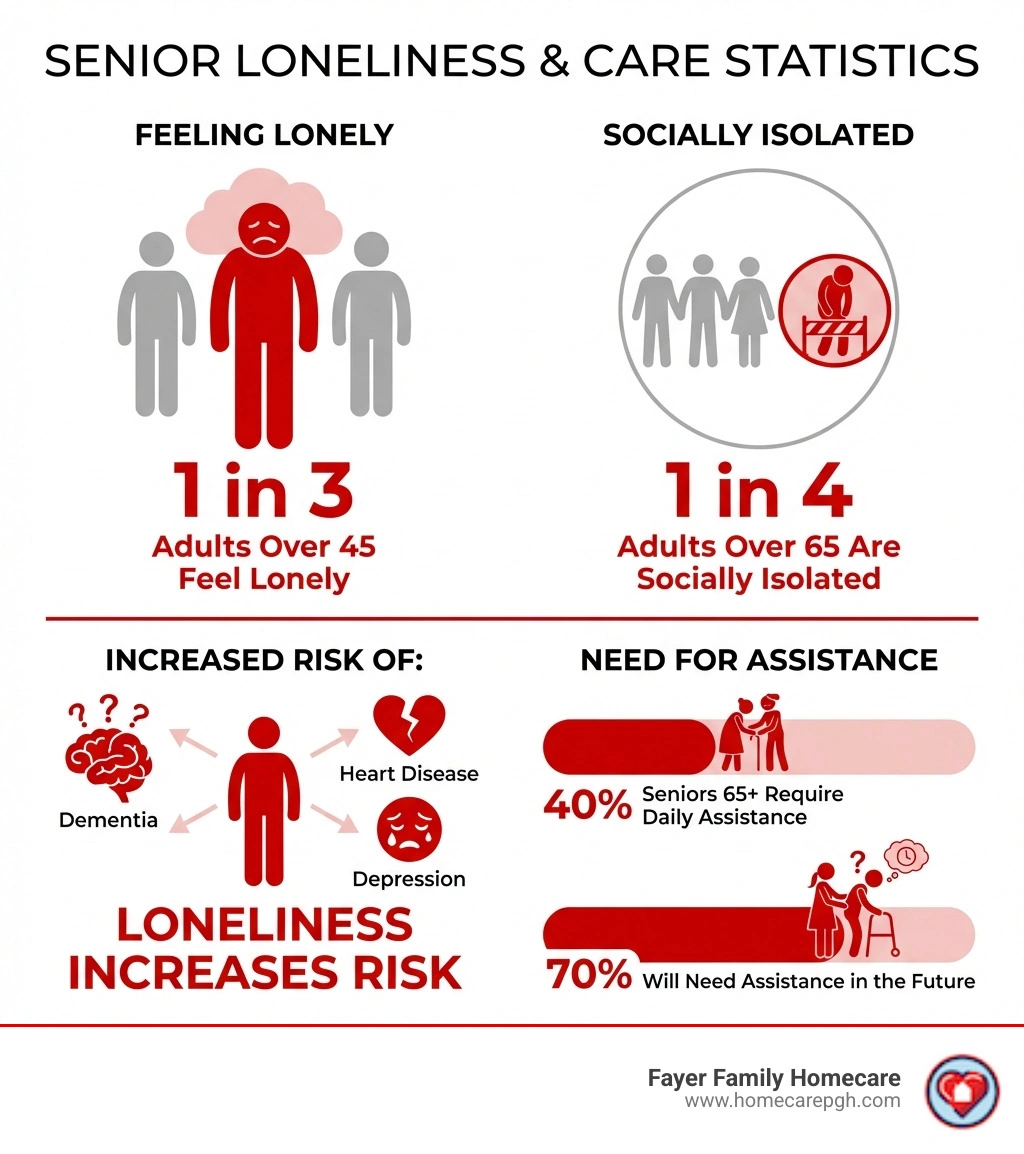
Senior companion care services terms at a glance:
When families begin researching support for an aging parent, the terminology can get confusing. You might hear terms like "home health," "personal care," and "companion care" used interchangeably, but they represent very different levels of support.
Senior companion care services are primarily non-medical. While a home health aide might be sent by a doctor to change bandages or administer physical therapy after a surgery, a companion is there to support the "whole person" through socialization and emotional connection. The focus isn't on curing a disease; it’s on enhancing the quality of life.
At Fayer Family Homecare, we see companion care as a holistic approach. It’s about more than just checking boxes on a chore list. It’s about having a friend to talk to, someone to share a meal with, and a dedicated set of eyes to ensure the home remains a safe, comfortable environment.
| Feature | Companion Care | Home Health |
|---|---|---|
| Primary Focus | Socialization, emotional support, and daily tasks | Medical recovery and clinical care |
| Medical Tasks | No (Non-medical) | Yes (Wound care, injections, PT/OT) |
| Requirement | No doctor's referral needed | Requires a physician's order |
| Goal | Independence and quality of life | Medical stabilization or recovery |
| Duration | Flexible (hourly to 24/7) | Usually short-term/task-specific |
Understanding What is Companion Care and How Does it Differ from Caregiving is the first step in deciding which service fits your family's needs. If your loved one is physically healthy but struggling with isolation, forgetfulness, or the upkeep of their home, companionship is often the missing piece of the puzzle.
We humans are social creatures by nature. For seniors, however, the social circle often shrinks. Friends move away, mobility becomes limited, and driving may no longer be an option. This leads to a dangerous level of isolation.
According to CDC research on senior loneliness and isolation, social isolation is associated with a 50% increased risk of dementia and other serious medical conditions. This is where senior companion care services become a literal lifesaver.
Loneliness isn't just a feeling; it has a physiological impact. It can lead to higher blood pressure and a weakened immune system. A companion provides a "social lifeline," offering a reason to get out of bed, get dressed, and engage with the world. Simple acts like sharing stories or going for a walk can drastically improve a senior's mood and outlook on life.
The "use it or lose it" principle applies heavily to the brain. Engaging in conversation, playing card games, or working on a puzzle provides vital mental stimulation. For those living with early-stage cognitive decline, this regular engagement can help maintain cognitive abilities for longer. You can find more info about senior citizen companionship and how it specifically targets these mental health markers.
A companion acts as an early warning system. They notice if a senior is suddenly more confused, if they have lost weight, or if they are becoming unsteady on their feet. By monitoring these subtle changes, we can often prevent a fall or a medical crisis before it happens.
If you are a family member providing care, you know the "caregiver burden" is real. It is the physical, emotional, and financial toll that comes with being the primary support for an aging loved one. You want to be there for them, but you also have a job, perhaps children of your own, and your own health to maintain.
Many family caregivers suffer from chronic stress because they feel they must be "on call" 24/7. Senior companion care services provide essential respite. Whether it’s a few hours a week or night companion for elderly support, professional care allows you to step back, recharge, and return to your loved one with more patience and energy.
Often, the relationship between a parent and an adult child can become strained when the child has to take on a "parenting" role—nagging about chores or medication. Bringing in a professional companion allows the family to return to their natural roles. You get to be the son or daughter again, while we handle the supervision and daily tasks.
For a deeper dive into balancing these roles, check out our Caregivers and Companions Ultimate Guide. Our goal at Fayer Family Homecare is to supplement the care you provide, ensuring your loved one is never alone or unsafe.
What does a typical day look like with a senior companion? It’s a blend of practical help and joyful interaction. Because every senior is unique, these services are highly customizable.
For a full list of how these tasks integrate into a care plan, refer to our Companion Care Services Complete Guide.
Deciding to start senior companion care services involves understanding the different "models" of care available and how families typically fund them.
The Companion Care Services Cost varies based on the level of care and the number of hours required. Generally, companion care is more affordable than assisted living or skilled nursing facilities because it allows the senior to remain in their own home.
In Pennsylvania, some costs may be covered if the senior is eligible for certain waivers (like the Elderly Waiver), but the majority of companion care is funded through private pay or long-term care insurance.
Generally, no. Medicare is designed to cover "acute" medical care—doctors, hospitals, and short-term home health after an injury. Because companion care is considered "custodial" or non-medical, it is typically not covered by standard Medicare. However, some Medicare Advantage plans are beginning to offer limited companion benefits, so it is always worth checking your specific policy.
No. Because these are non-medical services, you do not need a prescription or a referral from a physician. You can reach out to a provider directly whenever you feel the need for extra support.
Look for agencies that are locally based and have a strong reputation in your community. Ensure they perform rigorous background checks and focus on "caregiver matching"—pairing your loved one with someone who shares their interests and personality. A good provider will offer a free in-home evaluation to understand your family's specific needs before starting care.
At Fayer Family Homecare, we believe that aging shouldn't mean losing your connection to the world. Our senior companion care services in the Greater Pittsburgh Area are designed to bring light, safety, and friendship back into the home. Whether your loved one needs specialized dementia companionship care, Alzheimer's supervision, or just a friendly face to help with the laundry and a crossword puzzle, we are here to help.
We treat our clients with the same dignity and respect we would want for our own family members. By handling the daily stresses of housekeeping and safety monitoring, we allow you to focus on what matters most: enjoying your time with your loved one.
If you're ready to explore how companionship can transform your loved one's life, reach out to us today. Let’s work together to ensure your family member remains independent, comfortable, and—most importantly—never alone.

January 9, 2025
Senior Citizen Companionship: A Guide to Emotional and Physical SupportDiscover the benefits and services of senior citizen companionship to enhance quality of life and emotional support for seniors.
Read Article
January 5, 2026
Senior Fun: Finding the Right Activity Programs for Older AdultsBoost health & happiness! Discover engaging elderly activity programs for physical, mental, and social well-being. Find resources.
Read Article
September 14, 2026
Parkinson's Daily Living Assistance and Practical Mobility StrategiesDiscover practical Parkinson's daily living assistance tips for hygiene, mobility, safety, and caregiver support to improve quality of life.
Read Article