August 14, 2025
The Ultimate Guide to Reliable Senior House Cleaning ServicesDiscover senior house cleaning tips, services, and safety advice for a healthier, clutter-free, and comfortable home for older adults.
Read Article
.svg)


Care for Alzheimer's and dementia is one of the most demanding responsibilities a family member can take on — and one of the most important.
Here's a quick overview of what effective dementia care involves:
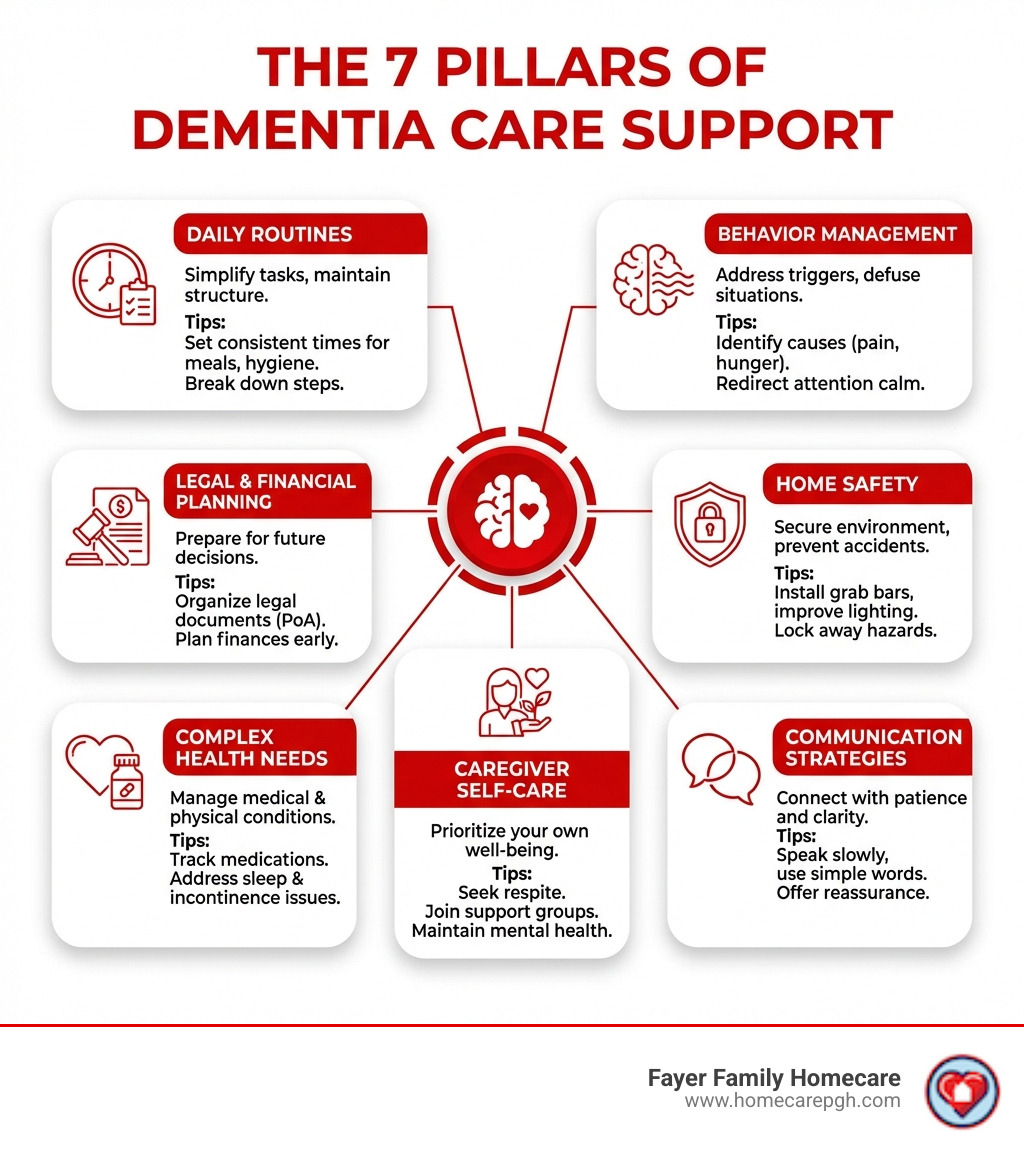
| Area | Key Focus |
|---|---|
| Daily routines | Bathing, dressing, grooming, mealtimes |
| Behavior management | Agitation, wandering, sundowning |
| Home safety | Fall prevention, lighting, locked hazards |
| Communication | Calm reassurance, simple language, patience |
| Health needs | Sleep, incontinence, medication, end-of-life |
| Caregiver self-care | Respite, support groups, mental health |
| Planning ahead | Legal documents, financial prep, care options |
Millions of Americans are caring for a parent or loved one with Alzheimer's or a related dementia right now. If you're one of them, you already know the weight of it — the emotional exhaustion, the uncertainty, the fear of getting something wrong.
The disease doesn't stand still. Neither do its demands. What works in the early stages often stops working months later. Behaviors that seem sudden usually have a reason. And the caregiver — often a middle-aged adult juggling their own life — is frequently the last person to ask for help.
This guide gives you practical, stage-by-stage strategies to manage daily care, handle difficult moments, keep your loved one safe at home, and protect your own well-being in the process.
You don't have to figure this out alone.
When we talk about care for alzheimer's and dementia, it is vital to remember that these are two different but related terms. Dementia is an umbrella term for a decline in mental ability severe enough to interfere with daily life, while Alzheimer’s is a specific disease that accounts for 60% to 80% of all dementia cases. In Pittsburgh and the surrounding Allegheny County, thousands of families are navigating these waters every day.
The care your loved one needs will evolve. We generally categorize this progression into three main stages:
One of the best ways to provide care for alzheimer's and dementia while keeping your sanity is to establish a solid routine. Structure is a caregiver's best friend. It reduces the number of decisions your loved one has to make, which in turn reduces their anxiety.
We recommend a "person-first" approach. This means remembering that the person is not the disease. If your dad loved gardening in his Mt. Lebanon backyard, find ways to keep him involved in that hobby, even if it’s just sorting seeds or watering a single pot. Keeping them engaged in dementia activities at home helps maintain their sense of self.
Daily tasks that we take for granted can become major hurdles for someone with cognitive decline. Here is how we can make them easier:
Communication is often the first thing to break down. You might find yourself repeating the same answer ten times in ten minutes. It’s frustrating, but remember: they aren't trying to annoy you; they truly don't remember asking.
Safety is paramount when providing care for alzheimer's and dementia. Our homes are often full of "invisible" hazards that become dangerous as a person's depth perception and balance decline.
In Pittsburgh, many of our older homes have steep stairs and narrow hallways. We need to adapt these spaces. Start by removing all area rugs — they are the #1 trip hazard. Ensure there is high-contrast lighting in every room so they can clearly see where the floor ends and the wall begins.
Key safety modifications include:
For a deeper dive into making your space secure, see our guide on dementia safety at home.
As a caregiver, you are essentially a project manager for your loved one’s health. This involves everything from managing multiple medications to coordinating with doctors in the UPMC or AHN networks.
One of the most important things we can do is plan early. If your loved one is still in the early stages, involve them in the conversation about Alzheimer's care at home. Knowing their preferences now saves a lot of heartache later.
The later stages of the disease bring physical challenges that require specialized knowledge.
Don't wait for a crisis to handle the paperwork. You need to have a Durable Power of Attorney (for finances) and a Healthcare Directive (for medical decisions) in place while your loved one still has the legal capacity to sign them.
The costs of care can be overwhelming, but there are resources available, including VA benefits for veterans in the Pittsburgh area and various Medicaid waivers. We’ve put together an Alzheimer's care costs complete guide to help you navigate the financial side of things.
We cannot pour from an empty cup. If you are exhausted, sleep-deprived, and resentful, the quality of care for alzheimer's and dementia you provide will suffer. Caregiver burnout is a real medical condition characterized by physical, emotional, and mental exhaustion.
Signs of burnout include:
To avoid this, you must seek help. This isn't a sign of weakness; it's a strategy for long-term success. Reach out to local support groups through the Alzheimer’s Association Greater Pennsylvania Chapter. They offer a 24/7 Helpline (800.272.3900) that provides support in over 200 languages.
Most importantly, use respite care. Whether it's a friend staying for an afternoon or hiring caregivers for Alzheimer's for a few days, taking a break is essential. For more on this, read taking care of yourself as a caregiver.
It’s time when the "bad days" outnumber the "good days," or when your own health begins to suffer. If you are worried about your loved one’s safety while you are at work or sleeping, or if you feel you can no longer manage their physical needs (like lifting or bathing), professional help can provide the relief you need.
Start by identifying the patterns. Do they wander at a certain time of day? Ensure they have plenty of exercise during the day to reduce restlessness. You can also use "disguises" for doors, like painting them the same color as the walls or using a removable black mat in front of the door (some people with dementia perceive a black mat as a hole and won't step on it).
First, check for physical causes. Are they in pain? Do they have a UTI? If there’s no physical cause, use the "Redirect and Reassure" method. Don't ask "Why are you doing this?" because they don't know. Instead, say, "I can see you're upset. Let's go look at your photo album in the other room."
Providing care for alzheimer's and dementia is a journey of a thousand small steps. There will be days of deep connection and days of profound frustration. By establishing routines, modifying your home for safety, and planning for the future, you can ensure your loved one lives with dignity while you maintain your own health and "sanity."
At Fayer Family Homecare, we understand the unique challenges Pittsburgh families face. We are here to support you in the Greater Pittsburgh Area with experienced caregivers who specialize in companionship, supervision, and engaging recreational activities. We don't just care for the person; we support the whole family, ensuring your loved one is clean, comfortable, and safe.
If you're feeling overwhelmed, you don't have to do this alone. Reach out to us for professional care for Alzheimer's and dementia and let us help you find the balance you need.

August 14, 2025
The Ultimate Guide to Reliable Senior House Cleaning ServicesDiscover senior house cleaning tips, services, and safety advice for a healthier, clutter-free, and comfortable home for older adults.
Read Article
February 1, 2024
The Essential Role of Caregivers in Home Health CareAt the heart of caregiving are the caregivers - the unsung heroes who bring skills, knowledge, and a deep sense of compassion and dedication to every home they enter.
Read Article
October 15, 2024
The Best Home Care Agencies in Pittsburgh: Our Top PicksDiscover top home care agencies in Pittsburgh PA for personalized senior care. Enhance independence and quality of life today.
Read Article