
May 29, 2025
The Essential Guide to Home Care Services for SeniorsDiscover care in the home services for seniors—compare costs, types, and tips to choose the right home care for your loved one.
Read Article
.svg)

Overnight home care in Pittsburgh is professional, in-home support provided during nighttime hours — typically a shift of 8 to 12 hours — by a trained caregiver who stays awake and alert throughout the night.
If you need a quick answer, here is what you should know:
Nights are often the hardest part of caring for an aging parent. Your loved one gets up four times to use the bathroom. Or their dementia-driven confusion hits hard after 9 PM, and the calm person you know disappears. You lie awake listening for sounds, or you're already up helping — night after night, until you're running on empty.
This kind of exhaustion is real, and it's one of the most common reasons families start looking for professional overnight support. The good news is that the right overnight caregiver doesn't just protect your parent — it gives you your sleep back, and with it, the ability to actually be present for them during the day.
This guide walks you through everything you need to know to find the best overnight care option for your family in Pittsburgh.
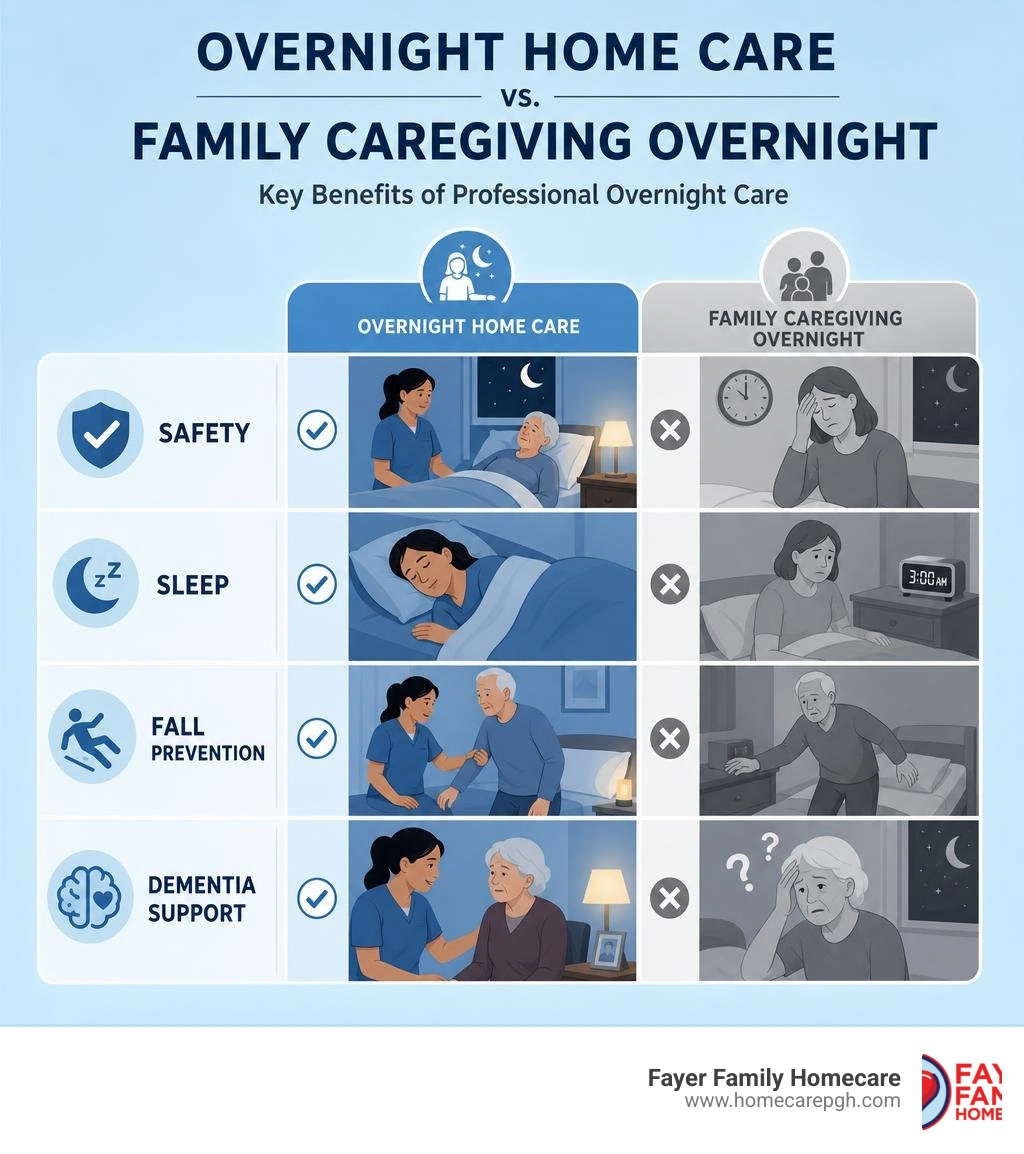
When families first begin researching how to support their aging parents after dark, they often encounter a confusing mix of terms: "overnight care," "live-in care," "24-hour care," and "shift-based care." Understanding the operational differences between these options is essential for making an informed choice that fits both your budget and your loved one's physical needs.
At Fayer Family Homecare, we believe that nighttime supervision should never be a guessing game. The primary goal of overnight care is to mitigate risks when the rest of the household is asleep. For many local families, this service is the missing piece of the puzzle that prevents caregiver fatigue from turning into full-blown physical and emotional burnout.

When evaluating options, the first step is understanding the difference between shift-based care and live-in arrangements. Shift-based care involves professional caregivers who work designated hourly shifts (usually 8 to 12 hours) and remain completely awake. This is highly distinct from a model where a caregiver lives in the home and sleeps overnight.
As you calculate your family's budget, it's helpful to review our average home care cost guide to understand how hourly rates fit into a broader, sustainable long-term care plan.
For seniors living in the Greater Pittsburgh area, overnight care is structured to provide targeted, alert supervision during the hours when emergencies are most likely to occur. This service typically begins in the late evening (for example, from 9:00 PM to 7:00 AM) and focuses entirely on safety monitoring, physical transfers, and cognitive reassurance.
A key feature of high-quality overnight care is the use of structured shift logs. When our professional caregivers arrive for an overnight shift, they don't just sit in a chair; they actively monitor the home environment, assist with bedtime routines, and document every event. If your loved one wakes up disoriented at 2:00 AM, the caregiver is there immediately to guide them safely. The caregiver records:
This level of active monitoring is why many families choose to hire a dedicated night companion for elderly relatives. It bridges the gap between independent living and institutional care, ensuring that your loved one has a compassionate, alert advocate by their side through the dark hours.
One of the most important distinctions you must make when choosing care is between live-in care and awake overnight care. Though they sound similar, their physical requirements, cost structures, and safety levels are vastly different.
In a live-in care arrangement, a single caregiver resides in the senior's home for a 24-hour period. However, by law and industry standards, a live-in caregiver must be provided with a private room and designated, uninterrupted sleeping quarters. They are expected to get a full night's sleep (typically 8 hours, with at least 5 hours of uninterrupted rest). If a senior frequently wakes up, wanders, or requires physical assistance multiple times a night, a live-in arrangement quickly breaks down. The caregiver becomes chronically sleep-deprived, which compromises their health and the safety of your loved one.
Conversely, awake overnight care utilizes shift-based scheduling. The caregiver does not sleep. They do not require a private bedroom because they remain fully awake, alert, and on duty in the common areas of the home, ready to respond instantly to any sound or movement.
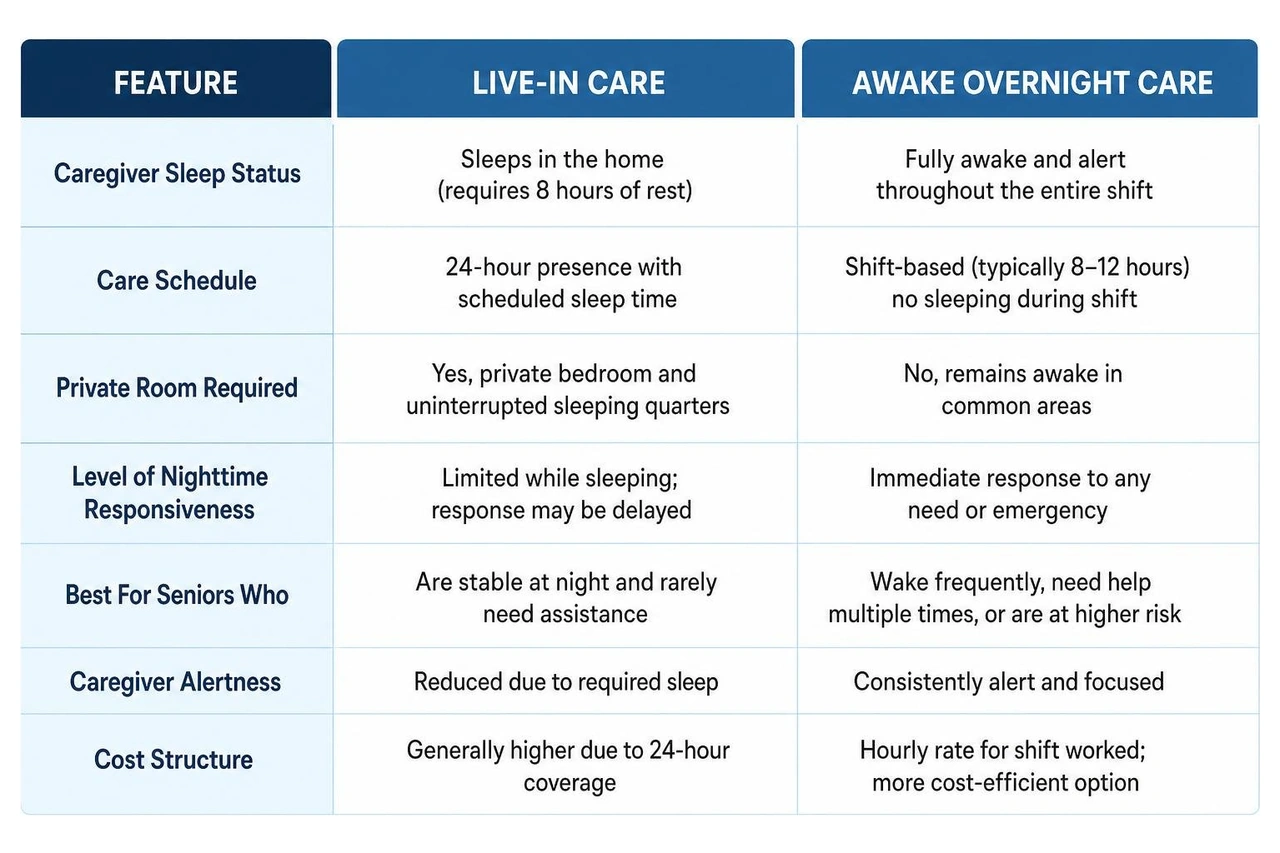
To help you compare these two pathways, we have summarized the core differences below:
| Feature | Live-In Care | Awake Overnight Care |
|---|---|---|
| Caregiver Sleep Status | Sleeps in the home (requires 8 hours of rest) | Fully awake and alert throughout the entire shift |
| Sleeping Quarters | Must provide a private room and bed | No private room or bed required |
| Best Suited For | Seniors who sleep through the night but need general 24-hour presence | Seniors with frequent nighttime awakenings, high fall risks, or sundowning |
| Billing Model | Usually billed at a flat daily rate | Billed at an hourly rate ($30 to $40/hr in 2026) |
| Caregiver Burnout Risk | High if the senior wakes up frequently | Low (shift-based rotations keep caregivers fresh) |
If you are trying to determine which model is the safest fit for your family's unique situation, exploring our comprehensive guide to in-home care options can help clarify your choices.
Overnight care is far more than just "passive watching." It is an active, hands-on service designed to keep your loved one safe, clean, and comfortable. When our caregivers step into a Pittsburgh home for the night, they take on a variety of critical responsibilities that directly support the senior's physical and emotional well-being.
Our core overnight services include:
For many seniors, the simple act of getting out of bed in the dark to use the bathroom is the single greatest threat to their independence. Balance issues, stiff joints from arthritis, medication side effects, and poor nighttime vision create a perfect storm for devastating falls.
Our caregivers are specifically trained in mobility transfer techniques. We don't just wait for a fall to happen; we actively work to prevent it. This includes assessing the home layout, ensuring that pathways are clear of clutter, and physically guiding the senior during nighttime bathroom trips.
By managing these physical challenges, we help seniors maintain their dignity while supporting their goal of aging in place pittsburgh style—safely navigating the unique layouts of local homes, whether they are historic row houses in Lawrenceville or multi-level homes in the South Hills.
Dementia and Alzheimer’s disease frequently disrupt a senior’s circadian rhythm. This often leads to a phenomenon known as "sundowning," where confusion, anxiety, and agitation spike in the late afternoon and evening. Seniors with advanced dementia may wake up at 2:00 AM completely convinced that they need to go to work, cook a meal, or leave the house, presenting a severe risk of nighttime wandering.
Managing these behaviors requires specialized training, patience, and a calm, reassuring presence. Our caregivers utilize evidence-based techniques recommended by organizations like the Alzheimer's Association to de-escalate nighttime confusion:
Securing professional support is a vital step in maintaining dementia safety at home, protecting your loved one from the dangers of wandering into the cold Pittsburgh night.
As degenerative conditions like Parkinson's, Alzheimer's, or general physical frailty progress, a family's care needs will naturally evolve. Overnight care is often an excellent, cost-effective starting point for families who can still manage daytime needs themselves but need professional support at night. However, there comes a point when care scaling is necessary to ensure continuous safety.
Transitioning to 24-hour care involves moving from a single nighttime shift to a continuous, round-the-clock schedule. To prevent caregiver fatigue and maintain high standards of safety, we utilize a team of rotating caregivers. This ensures that the professionals in your home are always rested, alert, and capable of providing the highest quality of professional 24-hour support.
If you are unsure whether it is time to hire professional support, look for these common warning signs during your visits:
Recognizing these signs early can prevent a catastrophic injury. If you notice these behaviors, it is time to explore structured 24-hour home care pittsburgh options to restore safety to your household.
The first 30 days following a hospital discharge represent the highest risk period for senior readmission. Interestingly, the vast majority of these readmissions trace back to incidents that occur overnight—a fall during a late-night bathroom trip, a missed dose of a critical new medication, or an undetected change in physical condition.
Coordinating overnight care prior to discharge is the best way to mitigate this risk. Our team works closely with hospital discharge planners at local health systems—such as UPMC and AHN (Allegheny Health Network)—to ensure a seamless transition. By having an overnight caregiver in place the very first night your loved one returns home, you establish a critical safety net. The caregiver provides diligent medication oversight, assists with mobility as surgical wounds heal, and gives the family immediate peace of mind during a highly stressful transition.
Navigating senior care options can feel overwhelming. Below are direct, clear answers to the most common questions Pittsburgh families ask about setting up overnight care.
In Pittsburgh in 2026, awake overnight home care typically costs between $30 and $40 per hour. This means a standard 10-hour shift (such as 9:00 PM to 7:00 AM) ranges from $300 to $400 per night.
Most families fund this care through private pay or long-term care insurance. If your loved one is eligible for Pennsylvania's Medicaid waiver program (Community HealthChoices), some or all of these costs may be covered, though the enrollment and approval process for state-funded programs typically takes 45 to 90 days. Private pay remains the fastest way to secure immediate, flexible care.
For standard overnight care, our caregivers remain fully awake and alert throughout the entire shift. They do not sleep. They are on active duty, performing safety checks, keeping detailed shift logs, assisting with personal care, and responding instantly to any nighttime needs. Sleep shifts are only appropriate in very low-risk situations where a senior sleeps soundly but simply feels more secure having an adult in the house.
At Fayer Family Homecare, we understand that care needs can arise suddenly, especially following an unexpected hospital discharge or a sudden decline in health. Once you contact us, we can typically conduct a free in-home care assessment and place a compassionate, experienced caregiver in the home within 3 to 5 business days. We pride ourselves on our scheduling flexibility and rapid response times to support local families when they need us most.
No family should have to choose between their own physical health and the safety of an aging parent. Sleep deprivation is a powerful force that can strain relationships and compromise your ability to care for your loved one during the day. Professional overnight home care is not a luxury—it is a vital safety measure that protects your loved one's independence while giving you your nights back.
At Fayer Family Homecare, we are proud to serve families throughout the Greater Pittsburgh Area, providing specialized, compassionate support for seniors aging in place, including those living with Dementia or Alzheimer’s. Our experienced caregivers are dedicated to ensuring cleanliness, comfort, and safety in every home we enter.
Let us help you find the peace of mind you deserve. Explore our home care services today, or contact us to schedule your free in-home assessment.

May 29, 2025
The Essential Guide to Home Care Services for SeniorsDiscover care in the home services for seniors—compare costs, types, and tips to choose the right home care for your loved one.
Read Article
May 6, 2026
A Comprehensive Guide to Aging in Place PittsburghDiscover aging in place Pittsburgh: expert tips, home mods, care services & resources to stay independent in your Pittsburgh home.
Read Article
May 11, 2026
Pittsburgh Home Care: Comfort, Compassion, and Convenience DeliveredDiscover compassionate home care in Pittsburgh for seniors. Learn about services, benefits, and how to choose the right provider for aging in place.
Read Article