
October 20, 2025
Home Care Assessment: Your Path to Personalized SupportDiscover what an in home care assessment entails. Get personalized support, ensure safety, and prepare for a successful care journey.
Read Article
.svg)

24-hour home care in Pittsburgh gives seniors round-the-clock support from trained caregivers — right in their own home. Here's what families typically want to know at a glance:
Some moments make it clear that part-time help isn't enough anymore. Maybe your parent fell during the night. Maybe their dementia has progressed to the point where they can't safely be alone — even for an hour. Maybe a hospital discharge happened faster than anyone expected.
These are the moments families search for answers.
The good news: you don't have to choose between a nursing home and doing everything yourself. 24-hour home care lets seniors stay in a familiar environment while receiving continuous, professional support — day and night.
This guide explains exactly how it works, when it's the right fit, what it costs, and how to get started in the Pittsburgh area.
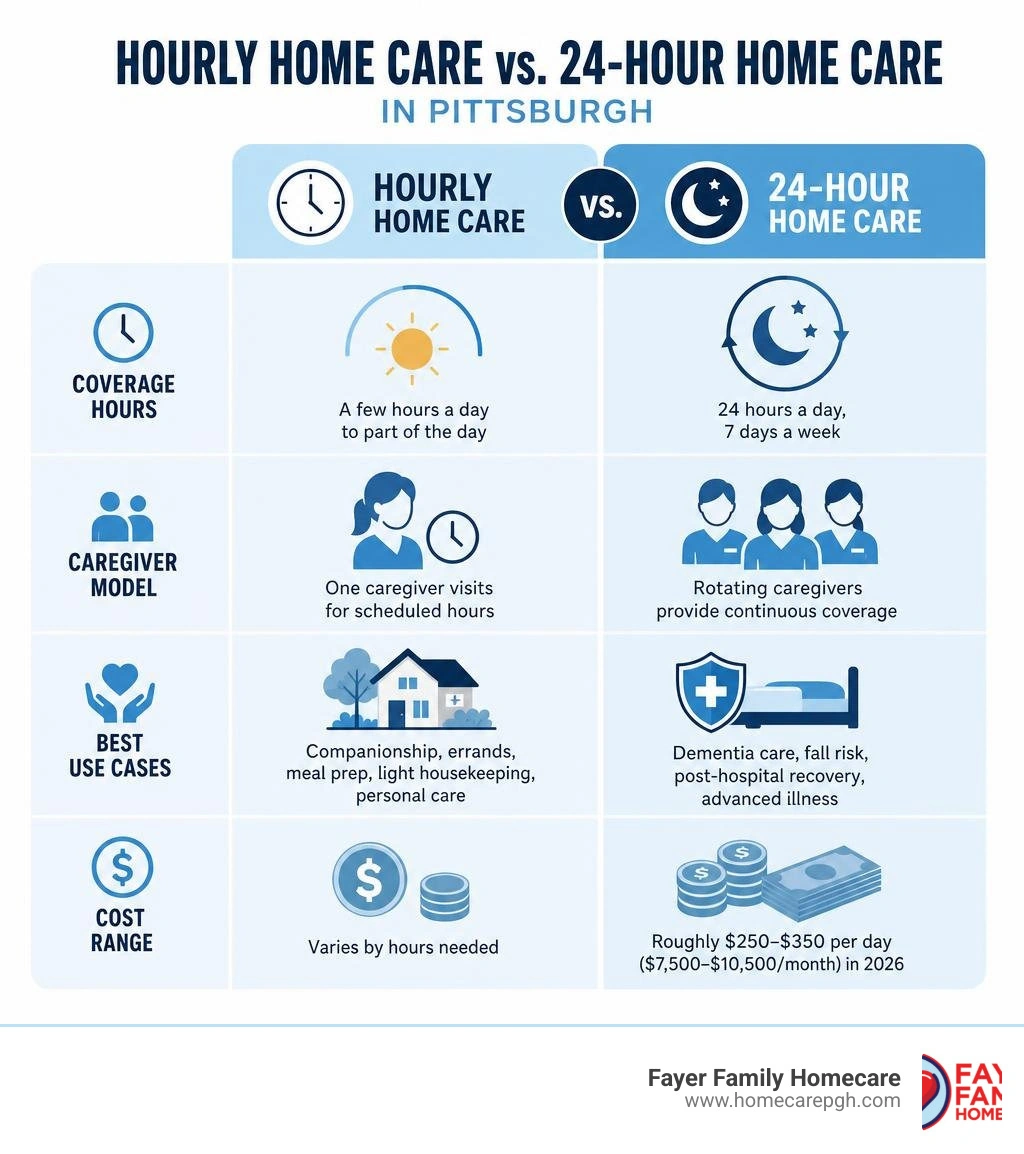
When looking into round-the-clock care, many families are surprised to learn that "24-hour care" is not a single, one-size-fits-all service. In fact, there are distinct ways to structure this level of support depending on your loved one’s daily routine, medical conditions, and safety risks.
Choosing the right structure is key to ensuring your parent receives high-quality care while keeping your budget manageable. If you want to dive deeper into companion-focused options, you can read more about 24/7 Live-In Companions to see how live-in care differs from shift-based options.
At its core, 24-hour home care is designed for seniors who require continuous supervision and safety monitoring. Unlike basic hourly care, where a caregiver might visit for a few hours in the morning to help with breakfast and bathing, 24-hour care means there is a professional in the home during every single hour of the day and night.
This level of care is non-clinical but highly comprehensive. It focuses on keeping your loved one safe, comfortable, clean, and emotionally engaged. For a broad look at how this fits into the wider landscape of local senior services, you can explore our Home Care Pittsburgh Complete Guide.
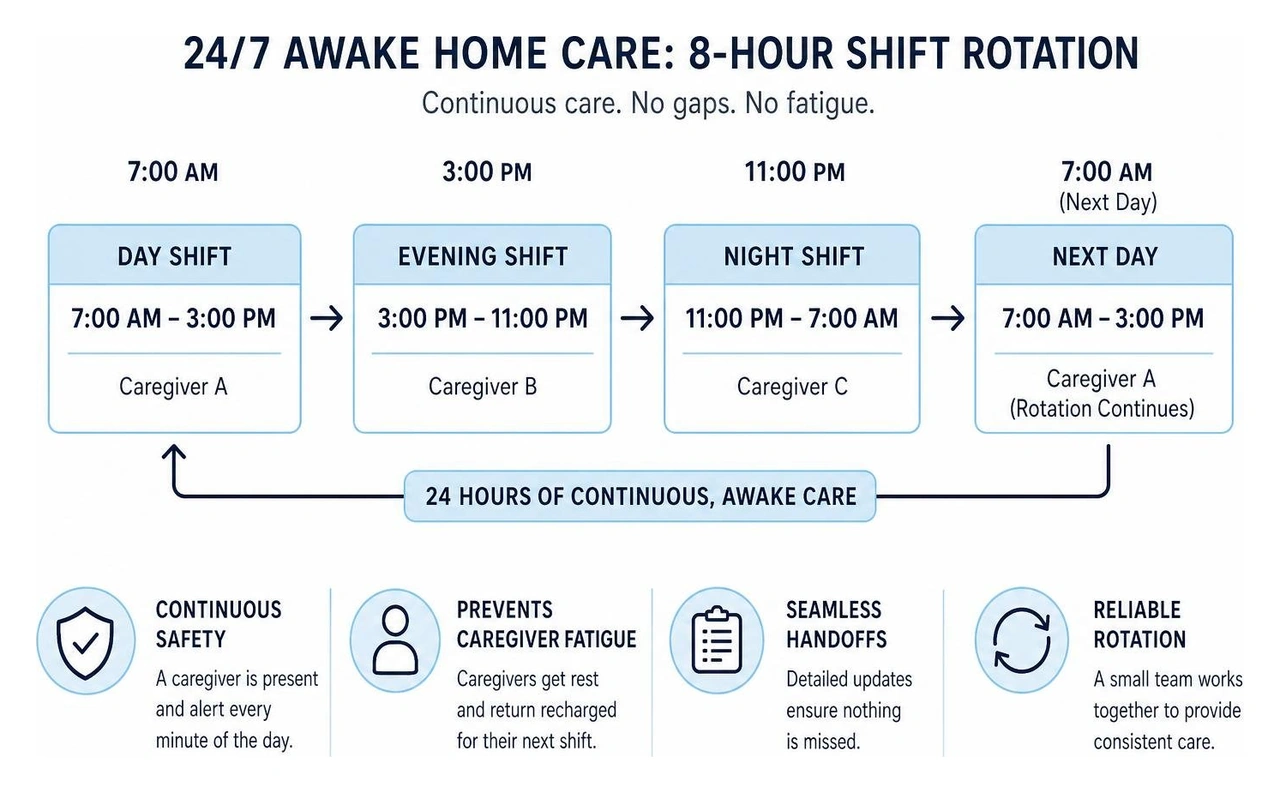
The most reliable way to provide continuous, high-supervision care is through a shift-based model. In this setup, we organize a small, dedicated team of caregivers who rotate in shifts (usually 8-hour or 12-hour increments) to cover the entire day.
This shift-based approach provides incredible flexibility. If you are interested in how schedules can be tailored to your family's exact needs, check out our guide on Flexible Home Care.
Having an awake, alert caregiver in the home overnight is a game-changer for senior safety. If your loved one wakes up disoriented at 2:00 AM, there is someone right there to guide them safely to the restroom, prevent a fall, or offer a warm cup of water.
This model of continuous awake care offers several distinct advantages:
To learn more about how continuous care compares in terms of structure and financial planning, you can read our Live-In Companion Elderly Cost Guide.
It can be difficult to pinpoint exactly when a senior transitions from needing "a little help" to needing continuous, around-the-clock supervision. Often, a single crisis—like a midnight fall or a stove left burning—makes the decision for you. However, recognizing the early warning signs can help you put care in place before an accident happens.
If you are currently evaluating your options, reading about Why You Should Consider Hiring a Home Health Care Agency can help clarify the decision-making process.
Dementia and Alzheimer's disease are among the most common reasons families seek 24-hour home care in Pittsburgh. As cognitive decline progresses, seniors lose the ability to assess danger or care for their own basic needs.
To see how professional support can help your loved one maintain their dignity and stay in familiar surroundings, read about 5 Ways Home Care Services Can Help Seniors Stay Independent.
The first 30 days after a hospital discharge are a high-risk period for seniors. Whether recovering from a major orthopedic surgery, a stroke, or a severe illness, the transition from hospital to home requires meticulous coordination.
Our caregivers can act as a crucial bridge during this recovery phase. We assist with medication reminders, monitor for physical changes, help with safe transfers out of bed, and ensure that discharge instructions are followed precisely. This intensive, short-term 24-hour support drastically reduces the risk of hospital readmission.
For families seeking a blend of clinical and non-clinical recovery options, our resource on Home Health Pittsburgh PA offers great insights into coordinating post-hospital care.
When you establish a 24-hour care plan, the goal is to cover every aspect of daily living so your loved one can live comfortably, cleanly, and safely. To get a complete overview of what can be customized for your family, you can explore our resources on In-Home Care in Pittsburgh PA and Home Care Services in Pittsburgh PA.
The core of daily care revolves around Activities of Daily Living (ADLs). Our experienced caregivers provide gentle, respectful assistance with tasks that may have become difficult or painful for your loved one:
For more details on how these services are structured, you can refer to our guides on Assistance with ADLs, Assistance with Daily Living, and Personal Care Services.
While daytime care focuses heavily on activity, nutrition, and companionship, overnight care is all about safety and quiet vigilance.
Our overnight awake caregivers focus on:
For families who do not require medical nursing but need strict safety and lifestyle support around the clock, you can learn more about how non-clinical care works by reading about Non-Medical Home Health.
One of the most important steps in arranging care is understanding the financial landscape. Because 24-hour care requires multiple shifts of caregivers, it is a significant financial investment, but it is often highly competitive when compared to the cost of private-pay nursing homes.
In 2026, 24-hour home care in Pittsburgh typically costs between $250 and $350 per day, which translates to roughly $7,500 to $10,500 per month.
While this is a substantial sum, consider how it compares to facility-based care in the Greater Pittsburgh Area:
To better understand the pricing variables and how to budget for care, read our comprehensive Average Home Care Cost guide.
Most families utilize a combination of funding sources to pay for 24-hour care. While Medicare does not cover long-term, non-medical custodial care, there are several other paths you can take:
To find reputable local providers who can help you navigate these financial options, you can consult our directory of Pittsburgh Home Care Agencies or read our Best Home Health Agencies Pittsburgh Guide.
With private pay, 24-hour home care coverage can typically start within 3 to 5 business days. If your loved one is currently in a hospital or rehab facility and needs immediate care to be safely discharged, we can often expedite this timeline.
To begin the process, we conduct an initial consultation to understand your loved one's physical and cognitive needs. You can learn more about what to expect during this stage by reviewing our Free In-Home Care Assessment Guide and our article on the In-Home Care Assessment.
Yes. We believe that consistency is vital, especially for seniors experiencing cognitive decline or dementia. We do not send a rotating door of strangers into your home. Instead, we build a small, dedicated team of typically 2 to 3 primary caregivers and a consistent backup.
This allows the caregivers to form a genuine bond with your parent, learn their unique preferences, and establish a comfortable daily routine. If you want to know how we build these specialized schedules, read our Customized Care Plans Complete Guide.
Yes, particularly when you factor in the immense value of personalized, one-on-one care. In a traditional assisted living facility or nursing home, a small staff is responsible for an entire floor of residents. In contrast, 24-hour home care ensures that your parent is the sole focus of their caregiver's attention.
This direct supervision prevents falls, ensures proper nutrition, keeps your loved one clean, and offers constant companionship—all of which drastically improve their quality of life. For more information on how keeping your loved one at home can be structured, check out our resource on Care in the Home Services.
When a loved one reaches the point where they can no longer be left alone, it can feel like your family is running on empty. But you don't have to navigate this journey by yourself.
At Fayer Family Homecare, we specialize in providing compassionate, high-quality care for individuals who are aging or living with Dementia and Alzheimer’s. Serving the Greater Pittsburgh Area, our experienced caregivers are dedicated to ensuring cleanliness, comfort, and safety for your loved one, while providing invaluable peace of mind for your entire family.
Whether you need immediate, short-term support after a hospital stay or are looking to build a long-term, round-the-clock safety net, we are here to help your family age with dignity.
Ready to take the next step? Explore our Fayer Family Homecare Services or Contact us today to schedule your free in-home care assessment.

October 20, 2025
Home Care Assessment: Your Path to Personalized SupportDiscover what an in home care assessment entails. Get personalized support, ensure safety, and prepare for a successful care journey.
Read Article
July 6, 2026
How to Create a Custom Care Plan for Optimal Well-beingDiscover how customized care plans boost senior well-being, independence & health outcomes. Learn 5 steps to create yours today!
Read Article
October 2, 2023
Stay Active, Stay Healthy: How Senior Home Care Supports Active AgingAging is a natural part of life, but it doesn't mean we should stop living life to the fullest. In fact, embracing an active lifestyle as a senior is critical.
Read Article